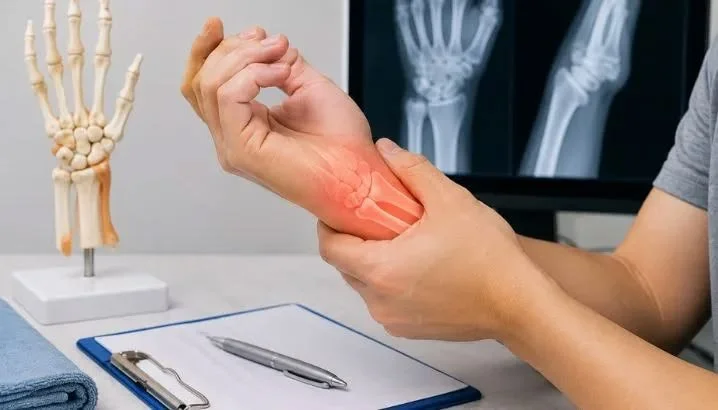
Illustrative photograph. A clinical examination and appropriate imaging help distinguish a fracture from other wrist injuries.
Pain on the thumb side of the wrist after a fall can be a scaphoid fracture even when the first X-ray looks normal. The wrist may need protection and further imaging rather than being treated as a simple sprain. Get medical advice promptly if a fracture is possible, and follow the assessment team's instructions about a splint and follow-up. PRP is not part of routine treatment for an acute scaphoid fracture. A joint and soft tissue consultation at The London PRP Clinic costs £150.
What matters after a fall onto the hand?
A normal first X-ray does not always exclude a scaphoid fracture.
Being able to move the wrist or grip something does not reliably rule it out.
Protection and planned review matter while the diagnosis remains uncertain.
MRI can identify an injury that is not visible on an initial X-ray.
A confirmed fracture needs a treatment plan based on its position, stability and healing, not an injection chosen before the diagnosis.
What does a scaphoid fracture feel like?
The scaphoid is one of the small bones of the wrist, on the thumb side. It can break when a fall forces the wrist backwards, including a fall onto an outstretched hand on an icy pavement. Pain may be felt around the base of the thumb, with swelling or discomfort when gripping and using the hand. Some injuries cause less obvious pain than expected.
Tenderness in the small hollow on the back of the wrist near the thumb, called the anatomical snuffbox, can raise suspicion. It is not a diagnosis by itself. A sprain or bone bruise can be tender in the same area. A clinician considers the mechanism of injury, the examination and imaging together. Repeatedly pressing the area or trying loaded wrist movements at home will not safely settle the question.
Other wrist bones and ligaments can be injured in the same fall. Pain elsewhere in the wrist does not establish a particular ligament injury, and the location of pain alone is not enough to choose an injection. The useful first step is to identify what was injured and whether the wrist needs protection.
When does wrist pain need urgent care?
The NHS advises getting medical help as soon as possible if a broken wrist is suspected. Use NHS 111 for advice if the wrist is very painful, pain or swelling is getting worse, or it is difficult to use or move. Do not wait for a routine private appointment when symptoms need urgent assessment.
Go to A&E or call 999 if the injured wrist or hand is numb or tingling, has changed colour or shape, is at an odd angle, has a heavily bleeding wound, or has bone visible through the skin. Do not drive yourself to A&E. These features can indicate an injury that needs emergency treatment, not a photograph review or a message exchange.
While arranging care, avoid using the injured wrist. Remove rings and a watch if you can do so easily before swelling increases. A wrapped cold pack may help discomfort, but keep ice off the skin. Follow the advice of the urgent-care team about pain relief and preparation for assessment.
Why can the first X-ray look normal?
A fine fracture line may be difficult to see immediately after the injury. The angle of the image also matters, which is why clinicians may request dedicated scaphoid views rather than relying on a general wrist image. A reassuring initial report has to be interpreted alongside the examination.
If the clinical findings still suggest a fracture, the next step is not simply to resume normal activity and see whether it hurts. The British Society for Surgery of the Hand recommends immobilising the wrist in a splint and arranging specialist review or MRI when a scaphoid fracture is suspected but not visible on radiographs.
Some pathways use repeat X-rays after 10 to 14 days. Others arrange early MRI. NICE recommends considering MRI as first-line imaging after a thorough clinical examination. The exact route depends on the injury and local service, but there should be a clear plan for resolving the uncertainty. Attend the scan or review even if the wrist starts to feel easier.
What is the difference between MRI and CT?
MRI is useful when a fracture is suspected but not visible on the first X-ray. It can help establish whether a hidden fracture is present. BSSH recommends MRI as the preferred investigation in this situation, with a definitive management plan within two weeks of presentation in its acute adult standards.
CT gives detailed information about bone alignment and the fracture gap. When a fracture is already visible, a hand specialist may use CT to assess how far the pieces have moved. CT can also be used later to assess whether the bone has joined. The scans answer different questions; a more expensive scan is not automatically the better choice for every stage.
These are clinical pathway standards, not a promise that a particular scan or appointment is available at this clinic within that time. If you have been discharged with a splint but no clear follow-up instructions, contact the service that assessed you or NHS 111 rather than leaving a possible fracture unresolved.
Why does the blood supply matter?
The scaphoid has an unusual blood supply. The part nearer the forearm, called the proximal pole, can be particularly vulnerable when a fracture disrupts that supply. This is one reason the precise location of the break matters as much as the level of pain.
A fracture that does not join is called a non-union. Avascular necrosis describes damage associated with loss of blood supply. These are different problems, although they can occur together. Persistent non-union can affect wrist mechanics and contribute to pain, weakness and arthritis over time.
These complications are not inevitable. Many scaphoid fractures heal with appropriate immobilisation and follow-up. The purpose of early assessment is to choose the right protection, identify fractures that need specialist treatment and check that healing is actually progressing. Less pain alone does not prove that the bone has joined.
How is a confirmed scaphoid fracture treated?
Treatment depends on the part of the bone involved, whether the fragments have moved and whether there are associated injuries. Many stable fractures can be treated in a cast. Some require surgery to stabilise the bone, often with a screw. Fractures at the proximal pole or those with displacement need careful specialist assessment.
Not every cast has to include the thumb. BSSH standards allow some waist and distal-pole fractures to be treated in a below-elbow cast with the thumb free. The correct cast or splint is chosen for the injury. A different-looking cast from someone else's does not mean the treatment is incomplete.
The time in a cast varies. Six weeks is common in some pathways, while other injuries need longer protection or surgery. A follow-up X-ray or CT may be needed before activity increases. The treating team should explain what you can use the hand for, whether the splint is removable and when the next assessment is due. Do not change that plan because a general online recovery guide gives a shorter timescale.
How can I look after the hand in a cast or splint?
Keep a cast dry and do not put objects underneath it to scratch the skin. Follow the instructions for any removable splint rather than taking it off for work, exercise or sleep without advice. Raising the hand can help swelling. Moving the fingers and unaffected joints as advised can help reduce stiffness without moving the injured wrist.
Contact the fracture service or NHS 111 if a cast becomes damaged, too tight or too loose, if pain increases, or if there is a bad smell or discharge underneath it. Numbness, marked swelling or blue or white fingers also need urgent advice. A cast should protect the injury, not cause progressive loss of feeling or circulation.
Avoid heavy gripping, pushing, pulling or lifting until the treating team allows it. That includes exercises such as press-ups and using the hand to push out of a chair. Advice about finger movement is not permission to load the wrist. If the written instructions are unclear, the fracture team can clarify the safe level of use.
What helps recovery after the cast comes off?
Stiffness and weakness are common after immobilisation. The skin can feel dry and the wrist may not immediately feel normal. Hand therapy may help restore movement, confidence and grip strength. Start the movements and loading programme recommended for your injury rather than forcing the wrist through pain.
Bone healing and return of full function are not the same milestone. Swelling, aching with heavier tasks and reduced flexibility can take months to settle. A persistent or worsening problem deserves review, particularly if pain returns as activity increases. Do not assume every later symptom is simply stiffness from the cast.
Smoking is associated with a greater risk of scaphoid non-union. Stopping is a practical way to support recovery, alongside keeping appointments and following protection advice. A clinician or pharmacist can help with stopping smoking. No supplement or injection replaces the need for a stable fracture and evidence of healing.
When can I drive, work or return to sport?
Return depends on the injury, treatment and the demands of the activity. Typing or other light duties may be possible before heavy manual work. Lifting, gripping tools and working at height place different demands on the wrist. A phased return may be more suitable than moving straight back to a full workload.
Do not drive until you have been told it is safe and you can control the vehicle properly. A cast, pain, reduced grip or sedating pain medicine can affect this. Check any relevant insurer requirements as well. Removing a splint just to drive is not a safe workaround.
Contact sport, skiing, snowboarding and gym exercises that load the wrist need specific clearance. Feeling comfortable during ordinary daily tasks does not mean the wrist is ready for another fall or forceful impact. The fracture team's assessment of healing should guide the return, not a fixed date taken from someone else's injury.
Does PRP have a role in a fresh scaphoid fracture?
PRP is not part of the routine acute scaphoid-fracture pathways described by NICE and BSSH. A suspected fracture needs diagnosis, protection and appropriate imaging. A displaced or unstable fracture may need surgical treatment. An injection is not a substitute for those steps.
If a fracture has failed to heal, a hand surgeon assesses why, including stability, alignment and blood supply. That is a different situation from a new injury after a fall. Treatment is chosen for the cause of the non-union. This article does not suggest that PRP can make an acute fracture heal faster or remove the need for a cast or operation.
For someone seeking an injection because wrist pain has continued, reassessing the diagnosis is often more useful than choosing a product first. A previous injury, an unhealed fracture or another wrist condition may need a different approach. The value of an assessment is a clearer next step, including referral when specialist fracture care is needed.
How much does a wrist injury assessment cost in London?
A joint and soft tissue consultation at The London PRP Clinic costs £150. If imaging or specialist care is recommended, confirm the appropriate route and any separate fees with the service providing it before booking.
Contact the team to arrange a wrist assessment.
Frequently asked questions
Can I move my wrist if the scaphoid is broken?
Yes, movement can still be possible. Mild pain or the ability to grip does not exclude a fracture. Thumb-side wrist pain after a fall needs assessment when a fracture is possible, especially if tenderness persists despite a normal first X-ray.
Does a normal MRI mean I can remove my splint?
Follow the instructions from the team reviewing the scan. The result must be considered with the examination and any other injury found. Do not stop protection or return to loading the wrist simply because you have read an isolated report without the agreed follow-up advice.
How long does a scaphoid fracture take to heal?
It depends on the location, stability and blood supply. Some injuries need around six weeks in a cast; others take longer or need surgery. Your follow-up examination and imaging guide the plan. Full strength and comfort can take longer to return than bone healing.
Should I wait two weeks before getting my wrist checked?
No. The repeat X-ray interval used in some pathways is not advice to delay the first assessment. Get medical advice promptly if a fracture is possible. A clinician can decide whether the wrist needs immediate protection, imaging and urgent or specialist review.
Why has my cast left the thumb free?
For some scaphoid fractures, immobilising the wrist in a below-elbow cast without including the thumb is an accepted approach. The choice depends on the fracture and the treating team's plan. Do not add or remove support yourself; contact them if the cast is uncomfortable or you are unsure about it.
Is PRP an alternative to a cast or surgery?
No. PRP is not routine treatment for a fresh scaphoid fracture. It does not replace protection, imaging or fixation when these are needed. Persistent pain after an injury should be assessed before considering treatment aimed at another wrist condition.
How to reach us
For a non-emergency enquiry, contact the team about a wrist assessment. Do not wait for a message reply if you have symptoms that need urgent or emergency care.
Message the team on WhatsApp about a wrist assessment.
Telephone, +44 20 3951 3429
Email, team@thewellnesslondon.com
Sources
NICE, Fractures (non-complex), imaging of scaphoid fractures
British Society for Surgery of the Hand, Scaphoid fracture standards
East Kent Hospitals, Scaphoid fracture
Gloucestershire Hospitals, Scaphoid fracture
King's College Hospital, Scaphoid fracture, conservative treatment