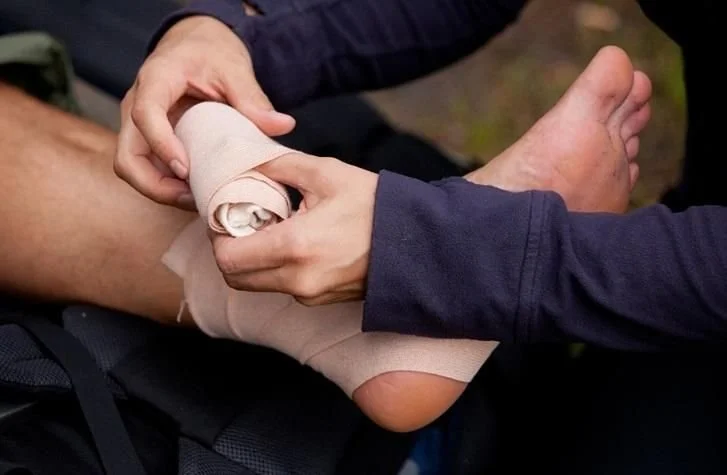
Illustrative photograph. A suspected ankle fracture needs assessment and appropriate protection, not a bandage alone.
Snowboarder's ankle is a fracture of the lateral process of the talus, a small bony prominence on the outer side of the ankle. It can feel like a sprain and may be difficult to identify on the first X-rays. Persistent tenderness after a snowboarding fall or hard landing needs proper assessment, and an injury that is very painful or difficult to bear weight on needs prompt advice rather than weeks of waiting. Treatment depends on the fracture and its joint involvement. PRP is not a treatment for an acute fracture. A joint and soft tissue consultation at The London PRP Clinic costs £150.
What is snowboarder's ankle?
The talus sits between the shin bones and the heel bone. Its upper surface contributes to the ankle joint, which allows the foot to move up and down. Beneath it is the subtalar joint, which helps the foot adapt to uneven ground and move from side to side. The lateral process is a projection on the outside of the talus, close to both of these important joint surfaces.
A break here is different from a torn ankle ligament, although the two can cause pain in much the same place. It is also different from a fracture of the outer ankle bone itself. The distinction matters because a treatment plan for a straightforward sprain may not provide enough protection for a fracture involving the joint surface.
The name comes from its association with snowboarding, but it is not confined to that sport. Falls, other sporting injuries and forceful landings can produce a similar injury. An accurate description of what happened is more useful than the name of the activity alone.
Why can it feel like a sprain?
Pain, swelling and bruising on the outside of the ankle occur with both injuries. Tenderness from a lateral process fracture is often just below and in front of the outer ankle bump, but swelling can make the location difficult to identify. Walking, turning the foot or moving over uneven ground may be uncomfortable. Some people can still walk despite the fracture.
Being able to take a few steps does not establish that the ankle is safe for sport. Equally, pain in this area does not prove that a fracture is present. Ligament injuries, other fractures, cartilage injuries and tendon problems can overlap. Examination and the right imaging are what separate these possibilities.
A clinician considers the mechanism, the precise tenderness, movement, circulation and sensation. They may also examine the rest of the foot and leg for associated injuries. Repeatedly testing the ankle by hopping or twisting it at home is not a reliable way to settle the diagnosis.
How does the injury happen?
A landing can force the ankle upwards while the loaded foot twists or rolls. Studies describe several combinations of movement, and there is no single position that explains every fracture. The practical point is that force is transmitted through the talus while the foot is held in an awkward position.
A person may not remember exactly how the ankle moved. They may only recall landing heavily, catching an edge or falling while the board remained attached. That uncertainty should not prevent assessment. Tell the clinician about the height or force of the landing, whether walking was possible afterwards, and whether pain began immediately or became clearer as swelling developed.
A high-energy accident may cause more than an isolated ankle injury. Pain elsewhere after a substantial fall also deserves attention. A lateral process fracture should be assessed as part of the whole injury, rather than treated as a small chip that cannot have wider consequences.
When does an ankle injury need urgent care?
Get medical advice promptly if a fracture is possible. NHS advice is to seek help from NHS 111 for an injured ankle that is very painful, increasingly swollen or bruised, painful to bear weight on, or very stiff and difficult to move. Do not wait three or four weeks for these symptoms to meet an arbitrary review threshold.
Go to A&E for an ankle at an abnormal angle, an exposed bone, a significant wound, severe pain, or toes that look blue or white or feel numb. Do not try to straighten a deformed ankle yourself. Do not drive yourself to A&E; arrange help or call 999 when an ambulance is needed.
While waiting for assessment, protect the ankle and avoid putting weight through it where possible. Raising the leg and using a cold pack wrapped in a towel can help with swelling. Do not put ice directly on the skin. Use pain relief that is suitable for you, following the packet or advice from a pharmacist or clinician. A painful ankle after a fall should not be exercised aggressively before a fracture has been considered.
Why can the first X-ray miss it?
The lateral process is small and lies among overlapping bones. A fracture line may be subtle or visible on one view but not another. Standard ankle X-rays remain useful, but a report of no obvious fracture does not always explain persistent, well-localised pain after a relevant injury.
The examination and X-ray findings need to be interpreted together. If a clinician remains concerned, further assessment and imaging may be appropriate. This is particularly important when the pain is concentrated around the lateral talus, the injury involved a hard landing, or recovery is not following the expected course.
A first diagnosis of a sprain can be revised as more information becomes available. Reassessment is about finding the explanation for symptoms, not assuming that every sore ankle needs a scan. It also avoids the opposite mistake: continuing an unsuitable sprain programme when a fracture has not been adequately excluded.
When is a CT scan useful?
CT provides detailed pictures of the bone and can help confirm a lateral process fracture. It shows the size and position of the fragment, whether it has broken into several pieces, and how the joint surface is affected. Those details can change the treatment plan, so CT may be needed even when a fracture is already suspected on an X-ray.
Specialist references identify CT as particularly useful for defining this injury. MRI may be chosen for a different clinical question, including an associated soft-tissue or cartilage injury, but the tests are not interchangeable in every situation. The clinician chooses the investigation according to what remains uncertain.
Ultrasound can be useful for some tendon and soft-tissue problems around the ankle. It is not a replacement for appropriate fracture imaging when a lateral talar process fracture is suspected. A reassuring soft-tissue scan should not be used on its own to dismiss continuing concern about a bone injury.
Why early diagnosis matters
The lateral process contributes to a moving, weight-bearing joint surface. If a fragment is displaced, the surface may no longer fit together as it should. If a fracture fails to unite or heals in a poor position, pain, stiffness or difficulty on uneven ground can persist. Damage to the cartilage can contribute to arthritis in the subtalar joint over time.
These are possible complications, not a prediction for every ankle. The risk depends on the injury, associated damage and treatment. Early recognition allows the ankle to be protected and the fracture pattern to be assessed before activities place repeated stress through it.
A small-looking fragment is not automatically a minor injury. Its location, displacement and effect on joint stability matter alongside its size. This is why a foot and ankle specialist may recommend a different plan from one based simply on the phrase small fracture.
How is snowboarder's ankle treated?
Treatment is individual. An undisplaced, stable fracture may be managed without an operation using immobilisation and restricted weight-bearing. Depending on the injury and local plan, protection may involve a cast or a suitable boot. The treating team decides how much weight is safe and when the ankle can start moving.
Displaced or fragmented fractures, significant joint-surface involvement or instability may need surgery. Options can include fixing a suitable fragment or removing a fragment that cannot be reconstructed. These choices depend on the actual images and examination; they cannot be decided from symptoms alone.
Professional guidance describes different approaches for different fracture patterns, and there is no single plan for every lateral process injury. A general six-week figure is not permission to stop using protection at six weeks. Follow-up checks establish whether the bone and joint are ready for the next stage.
What should happen during recovery?
The early aim is to protect healing while controlling swelling and maintaining safe movement elsewhere. Follow the instructions for a cast, boot and crutches, including whether protection is needed overnight and whether it can be removed for washing. Do not change weight-bearing because the ankle feels better for a day.
Tell the treating service if the cast or boot is rubbing, feels too tight, becomes loose as swelling falls, or no longer fits properly. Increasing pain, new numbness, burning, colour change in the toes, discharge or an unpleasant smell needs medical advice. Severe symptoms or poor circulation require urgent assessment.
Review appointments may include examination and further imaging. Keep them even if daily pain is improving. Comfortable movement does not by itself confirm that a fracture has united or that the joint surface is ready for the demands of sport.
Rehabilitation and returning to activity
Once the treating team allows it, rehabilitation works on ankle and foot movement, strength, balance and walking. Stiffness after immobilisation is common, but the pace of exercises has to match the fracture's recovery. Some discomfort from rebuilding movement is different from worsening focal pain, which deserves review.
Returning to running, jumping or snowboarding requires more than walking around the house. The ankle needs enough movement, strength and control for unpredictable loads, and healing must be adequate. Some people need several months before sport, particularly after surgery or a more complex injury. There is no reliable return date that applies to everyone.
Desk work, standing work and manual work place different demands on the ankle. Driving also needs individual advice, especially with a boot or cast, restricted weight-bearing or medicines that affect alertness. Being able to sit in a car is not the same as being able to control it safely.
What if the injury was diagnosed late?
An ankle that remains painful, catches, swells repeatedly or struggles on uneven ground after a supposed sprain deserves reassessment. This does not establish that a missed fracture is the cause, but it is a reason to revisit the diagnosis rather than simply repeat the same exercises indefinitely.
Bring any earlier X-ray reports, images, discharge letters and details of treatment to the review when available. The clinician can assess whether the problem relates to an unhealed fragment, joint-surface damage, a ligament or tendon injury, or another condition. Further imaging should answer a clear clinical question.
Delayed problems can still be assessed and treated, although options depend on what has happened to the bone and joint. A personalised plan is more useful than assuming that either nothing can be done or an injection will repair the original injury.
Where does PRP fit?
PRP is not routine treatment for an acute lateral process fracture and should not replace diagnosis, immobilisation, appropriate weight-bearing restrictions or surgery when indicated. A suspected fracture needs the appropriate fracture-care pathway, not an injection appointment intended to bypass it.
Persistent ankle pain after healing is a separate clinical problem. The cause needs to be established before discussing treatment. Evidence about injections for one ankle condition cannot simply be applied to a fracture or to every painful ankle. An assessment may lead to rehabilitation, specialist review or another approach rather than PRP.
For clients considering a private ankle consultation, the useful first step is a clear account of the injury and previous investigations. A routine clinic message is not an emergency service. If an acute fracture is possible or urgent warning signs are present, use urgent care rather than waiting for a reply.
How much does an ankle injury assessment cost in London?
A joint and soft tissue consultation at The London PRP Clinic costs £150. If imaging or specialist care is recommended, confirm the appropriate route and any separate fees with the service providing it before booking.
Contact the team about an ankle assessment after an injury.
Frequently asked questions
Can I walk with snowboarder's ankle?
Sometimes. Being able to walk does not rule out a lateral process fracture. Pain below the outer ankle after a forceful landing still needs assessment when a fracture is possible. Avoid using a trial run or repeated hopping to test it.
Does a normal X-ray exclude the fracture?
No. The fracture can be subtle on initial X-rays. If the clinical suspicion remains, CT may be needed to confirm the injury and define its joint involvement. The next investigation depends on the examination and what the first images show.
Should I wait several weeks before seeking help?
No. Seek prompt advice for a possible fracture, especially with significant pain, swelling or painful weight-bearing. Severe pain, deformity, a serious wound or numb or discoloured toes requires A&E assessment. Persistent symptoms after an initial review also deserve reassessment.
Does every lateral process fracture need surgery?
No. Some undisplaced, stable injuries can be treated with protection and restricted weight-bearing. Displacement, fragmentation, cartilage injury and instability can change the plan. A specialist uses the images and examination to decide whether fixation or another treatment is needed.
When can I return to snowboarding?
Only when the treating team considers healing and function adequate. Movement, strength, balance and tolerance of sport-specific loads matter as well as pain. Recovery can take several months, and a fixed calendar date should not replace individual review.
Can PRP heal this fracture?
PRP is not routine treatment for this fracture. Protection, assessment of the joint surface and sometimes surgery are the established priorities. Continuing pain after the fracture has healed needs its own diagnosis before any injection treatment is considered.
Sources
British Orthopaedic Foot and Ankle Society, Talar Process Fracture
AO Surgery Reference, Lateral process fracture: diagnosis and treatment principles
American Academy of Orthopaedic Surgeons, Talus Fractures
Orthopaedic Trauma Association, Talus Fracture