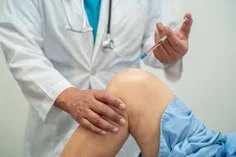
Illustrative photograph. Inner-knee pain needs a whole-knee assessment before treatment is chosen.
Pain along the inner side of the knee after a twist, tackle or skiing fall can come from the medial collateral ligament, usually called the MCL. The first decision is whether this is an isolated ligament injury or part of a more complex knee problem. That distinction matters more than choosing an injection in the first few days.
Many isolated MCL injuries are managed without surgery, using protection where needed and a progressive rehabilitation plan. PRP has been studied, including in a small randomised trial, but the evidence does not justify promising faster ligament healing or a particular return-to-sport date. Assessment should establish what is injured, how stable the knee is and whether the proposed treatment adds something worthwhile to rehabilitation.
For clients considering PRP in London, a clear diagnosis also helps avoid applying evidence from knee arthritis, tendon pain or an elite athlete's recovery to a different ligament injury.
What does the MCL do?
The MCL is a strong band of tissue on the inner side of the knee. It helps resist forces that push the knee inward. A sideways impact or a sudden change of direction can overstretch or tear it. Inner-knee pain, local swelling, tenderness and a feeling of giving way can follow. [1]
There are superficial and deeper parts of the medial ligament complex, with the deeper structures closely related to the medial meniscus. This helps explain why pain in this area needs a whole-knee assessment rather than treatment based only on the most tender point. Some deeper injuries can be difficult to distinguish from neighbouring problems. [5]
An MCL diagnosis should not be assumed from the location of pain alone. The history, examination and, where appropriate, imaging need to fit together. Pain that appeared gradually without a clear injury may require a different explanation from an acute ligament sprain after a definite sideways force.
What is the difference between a sprain, partial tear and complete tear?
Ligament injuries are commonly described in grades. A grade 1 injury involves mild damage while the ligament still helps keep the knee stable. A grade 2 injury is a partial tear with greater looseness. A grade 3 injury is a complete tear or separation from its attachment and can cause substantial instability. [1]
The grade is useful, but it is not the whole treatment decision. The location of the damage, whether the ligament has pulled away from bone, and whether the ACL, meniscus or other structures are injured also matter. A scan report containing the word tear does not mean every injury needs surgery, and the word partial does not mean an unstable knee can be ignored. [1,3]
A clinician assesses stability with controlled examination techniques and compares the injured knee with the other side. Repeatedly forcing the knee sideways at home to test the ligament is not a useful way to decide whether it is healing.
When should urgent assessment come before an injection enquiry?
NHS guidance recommends urgent advice through NHS 111 when a knee is very painful, cannot move or take weight, is badly swollen or has changed shape. Locking, giving way or painful clicking also merit urgent advice. A hot or red knee with a very high temperature or shivering can indicate infection. [2]
These symptoms should not be left until a routine PRP consultation, particularly after a significant injury. The immediate task is to identify a fracture, infection, major instability or another problem requiring prompt care. Being able to walk a short distance is useful information, but it does not replace assessment of the injury.
For less severe symptoms, protecting the knee from another twist and avoiding the activity that caused the injury are sensible while advice is arranged. Follow any instructions already given about crutches, a brace or weight bearing. A general article cannot safely change a plan made after examining your knee.
Will an MRI or ultrasound settle the diagnosis?
Clinical history and examination remain central. X-rays can identify a bone injury or a small piece of bone pulled away with a ligament, even though they do not directly show the ligament tear. MRI can show the MCL and other structures within the knee, which is useful when associated damage or the extent of injury needs clarification. [1]
Ultrasound can provide a dynamic view of the superficial and deeper medial structures when performed and interpreted by an appropriately experienced clinician. A 2025 report described two deep-MCL cases in which ultrasound contributed to assessment and guided injection. That is useful clinical illustration, not proof that ultrasound replaces MRI in every injured knee. [5]
The right investigation is the one that answers an unresolved clinical question. Imaging should support a decision about protection, rehabilitation, specialist review or treatment. Neither an MRI abnormality nor an ultrasound image establishes by itself that PRP is the best next step.
Why does rehabilitation usually come first?
AAOS guidance describes non-operative care for low-grade MCL injuries without associated injuries. Depending on the injury, that may involve a hinged brace for stability and physiotherapy to restore movement, strength and confidence. The aim is a knee that tolerates daily activity and progressively more demanding tasks, rather than pain relief alone. [1]
Rehabilitation is adjusted to the injury and its stage. Early protection and later strengthening serve different purposes. Someone with a stable low-grade sprain should not automatically follow the same restrictions as someone with a more serious or combined injury. Equally, discomfort improving after a few days does not establish readiness for cutting, contact or another skiing session.
A 2024 systematic review found wide variation in rehabilitation, brace use and weight-bearing advice. That uncertainty supports an individual plan with reassessment, not the claim that exercise is unimportant. It also means a rigid online programme cannot be presented as the single proven protocol for everyone. [3]
Does everyone need a knee brace?
Not necessarily. The need for a brace, its settings and the duration depend on stability, injury severity and associated damage. AAOS includes hinged bracing within non-operative MCL care, while the 2024 review found that studies used different approaches and often described them poorly. [1,3]
The review included 26 reports involving 1,912 people and found substantial differences between the populations and treatments. Evidence for individual rehabilitation and bracing approaches was generally of low or very low certainty. It does not establish that one brace or a fixed number of weeks is best for every MCL injury. [3]
If a brace has been fitted after assessment, its instructions take priority over a general blog. It should not be removed, locked differently or replaced with an online product simply because another person's recovery was quicker. The useful question for follow-up is how the knee's stability and function are changing under the current plan.
What is PRP intended to add?
PRP is prepared from a sample of the client's blood and contains a concentration of platelets. Interest in ligament treatment comes partly from laboratory work on the signalling molecules released by platelets and their possible effects on tissue repair. A biological explanation is a reason to investigate a treatment, not proof that it improves recovery in people. [4,6]
A systematic review of basic-science ligament studies found considerable variation in PRP preparations, experimental models and outcomes. Findings from animal or laboratory tissue cannot be translated directly into a reliable human healing time, an ideal dose or a guarantee that a ligament will regain normal strength. [6]
For an MCL injury, PRP would need to be judged as a possible addition to an appropriate care plan. It cannot replace protection from further injury, rehabilitation or assessment of instability. Evidence about PRP injected into an arthritic knee joint also cannot simply be reused as proof about an injured ligament beside that joint.
What did the 2024 randomised MCL trial find?
A small trial included 32 athletes aged 18 to 35 with recent MRI-confirmed grade 1 or 2 MCL injuries. Sixteen received ultrasound-guided PRP plus rehabilitation, and 16 received pulsed ultrasound treatment plus rehabilitation. Other ligament and meniscal injuries were excluded. Pain and knee-function scores were followed over 12 weeks. [4]
Both groups improved. The authors reported greater early improvement with PRP at two and six weeks, but reported no statistically significant between-group difference in the changes at 12 weeks. The paper also contains inconsistencies between some statistical results in its tables and narrative. That limits confidence in precise effect estimates and argues against treating its conclusions as settled. [4]
This was not a large placebo-injection trial, and both groups received rehabilitation. It does not establish the benefit of PRP over rehabilitation alone, demonstrate a reliable reduction in reinjury or settle long-term outcomes. Its young, selected athletic population also differs from an older person with arthritis, a complete tear or several structures injured together.
Do the 2025 deep-MCL cases change the answer?
A 2025 clinical report described two people with persistent pain attributed to the deep MCL, one after a traumatic injury and one with gradual symptoms and degenerative changes. Their symptoms improved after ultrasound-guided PRP following unsuccessful conservative care. The report helps describe a possible clinical problem and a procedure used to address it. [5]
Two cases without a control group cannot establish how much improvement was caused by PRP rather than time, rehabilitation or other factors. They also cannot predict how often treatment fails or define the best preparation, number of injections or aftercare. A favourable individual recovery is different from a dependable result across a wider group.
The distinction between that report and the acute-injury trial matters. Persistent deep-ligament pain and a fresh grade 1 or 2 sprain are not interchangeable populations. Combining them into a single success rate or a universal treatment pathway would hide important uncertainty. The evidence remains a reason for a careful discussion, not a reason to promise rapid ligament repair.
What if the knee is still painful or unstable?
Ongoing symptoms should prompt a review of the diagnosis and recovery plan. Possibilities include an injury that has not regained stability, associated meniscal or cruciate-ligament damage, or pain from another structure. The assessment should revisit the original mechanism, examination, available imaging and the rehabilitation completed, rather than automatically adding another treatment. [1,3,5]
Some MCL injuries, particularly certain attachment injuries or complex patterns, need an orthopaedic opinion. Persistent instability after non-operative treatment can also change the decision. A complete tear does not mean every person needs the same operation, but it should not be presented as something a PRP injection will reliably reconnect. [1,3]
If PRP is considered for persistent symptoms, the discussion should identify the intended target, the limits of the evidence and what meaningful improvement would look like. A plan should also explain when the response will be reviewed and what would lead to reassessment rather than repeated injections without a clear purpose.
How is return to sport decided?
Return should be a progression based on recovery, not a date taken from an athlete's case report. AAOS describes restoring movement and strength before gradual functional progression. Walking comfortably, controlled exercise, running, changing direction and contact activity place different demands on the knee. [1]
An improvement in pain after any intervention does not demonstrate normal ligament strength or control during a sudden turn. The clinician or physiotherapist needs to relate symptoms and examination to the demands of the intended activity. A knee that repeatedly gives way should not be pushed through a return programme simply because a holiday or match is booked.
The available MCL PRP studies do not establish one universally safe return-to-sport interval. Their findings should not be turned into a promise to ski within a month or compete by a particular weekend. A measured recovery plan is more useful than a fast timetable that the knee cannot tolerate.
Planning an assessment at The Wellness
For a discussion about knee pain and PRP, the useful starting information is how the injury happened, when it occurred, whether the knee locks or gives way, any existing diagnosis and the treatment already tried. Relevant scan reports and the current rehabilitation or brace instructions help put the symptoms in context.
The purpose is to establish whether an injection is a sensible option, whether rehabilitation needs attention or whether a different assessment should come first. This article does not establish that every MCL injury is suitable for PRP or that a particular image-guided procedure is included in a standard appointment.
A treatment discussion should cover alternatives, uncertainty, possible post-injection pain or swelling, infection risk and the possibility of no improvement. Your own blood does not make an injection risk-free. The right outcome is a clear, individual plan for the knee, which may or may not include PRP. [4,5]
Discuss knee pain and PRP suitability with The Wellness
Frequently asked questions
Can PRP heal an MCL tear faster?
Some small studies suggest early symptom improvement, but the evidence does not establish reliably faster healing or a guaranteed return-to-sport date. The 2024 trial compared PRP plus rehabilitation with pulsed ultrasound plus rehabilitation, not rehabilitation alone. Its size and reporting limitations matter. [4]
Does every MCL tear need surgery?
No. Many isolated injuries are managed without surgery. Stability, the tear's location and any associated knee damage guide the decision. Certain complex or persistent injuries need specialist review; the word tear alone does not select an operation or an injection. [1,3]
Can I walk if I have an MCL injury?
That depends on severity, pain, stability and the instructions given after assessment. Some injuries allow supported walking, while others need restrictions. Do not use a general PRP article to change weight-bearing or brace advice for your own knee.
Is an MCL injury the same as a meniscus tear?
No. The MCL is a ligament along the inner knee; the meniscus is cartilage within the joint. Their close relationship means symptoms can overlap or injuries can occur together. Examination and appropriate imaging help identify which structures need attention. [1,5]
Should I have PRP instead of physiotherapy?
The available MCL evidence does not support replacing rehabilitation with PRP. The small randomised trial included rehabilitation in both groups. Movement, strength and functional progression remain part of recovery even when another treatment is considered. [1,4]
When should I seek urgent help rather than book PRP?
Get urgent NHS 111 advice for very severe pain, inability to move or bear weight, major swelling, a changed knee shape, locking or giving way. A hot or red knee with fever or shivering can indicate infection. Urgent assessment takes priority over an elective treatment enquiry. [2]
Sources
AAOS OrthoInfo, Collateral Ligament Injuries
Svantesson and colleagues, 2024 systematic review of non-operative MCL rehabilitation
Devi and colleagues, 2024 randomised trial of PRP for MCL injury
Cruz and colleagues, 2025 report of two deep-MCL PRP cases
Kunze and colleagues, 2022 systematic review of basic-science PRP ligament studies