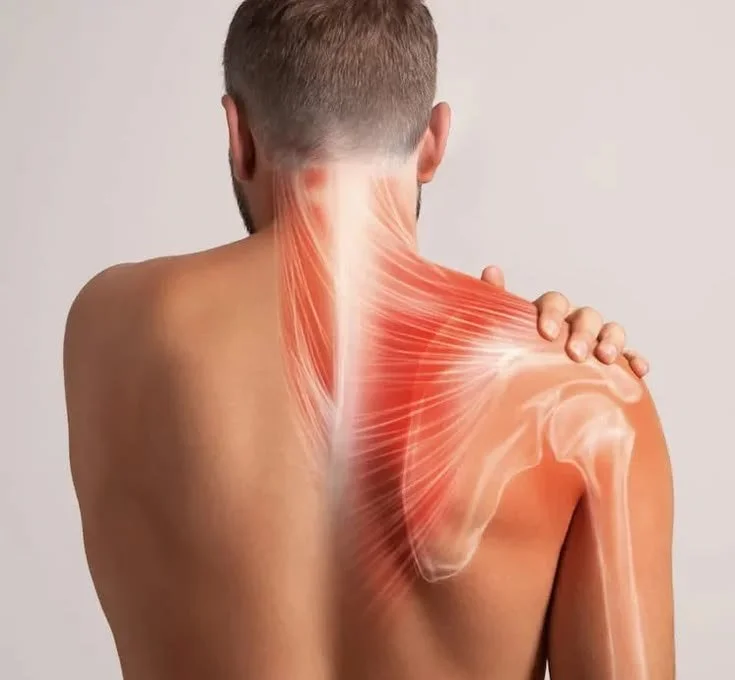
Illustrative photograph with a muscle overlay. The image does not show or diagnose suprascapular nerve compression.
Pain at the back of the shoulder with weakness deserves a different assessment from a painful tendon alone. One possible cause is suprascapular neuropathy, a problem affecting a nerve that supplies two of the rotator cuff muscles. The condition is uncommon, but recognising it matters when a shoulder is losing strength, muscle bulk or endurance.
For a client considering platelet-rich plasma, or PRP, the first question is what is causing the symptoms. An injection into a tendon or joint does not automatically address pressure on a nerve. Equally, a study comparing PRP with a suprascapular nerve block for frozen shoulder is not evidence that PRP repairs an entrapped suprascapular nerve. A clear diagnosis keeps those very different decisions separate.
What does the suprascapular nerve do?
The suprascapular nerve travels from the nerve network near the neck towards the shoulder blade. It supplies the supraspinatus and infraspinatus, muscles involved in lifting and rotating the arm. It also carries sensation from structures around the shoulder joint. This combination helps explain why a nerve problem can present as shoulder pain, weakness or both.
The nerve passes through relatively narrow areas around the shoulder blade. These include the suprascapular notch and, further along its course, the spinoglenoid notch. The location of a problem influences which muscles are affected. Compression nearer the first notch can affect both muscles, while a problem further along may mainly affect the infraspinatus. These anatomical distinctions are useful to the clinician, but they cannot establish a diagnosis from the location of pain alone.
How can it resemble a rotator cuff problem?
A deep ache behind or above the shoulder, discomfort during overhead activity and reduced strength can occur with suprascapular neuropathy. A client may notice that serving, lifting or working overhead feels less controlled or more tiring. In some cases there is visible loss of muscle bulk around the shoulder blade. Pain is not always prominent, particularly when the affected part of the nerve lies beyond some of its sensory branches.
Rotator cuff tendon disease can produce overlapping symptoms. A neck-related nerve problem, a labral injury and other shoulder conditions may also be relevant. More than one problem can be present at the same time. A tendon change on a scan therefore needs to be interpreted alongside the pattern of weakness and the examination, rather than assumed to explain everything.
The difference matters for PRP planning. Treatment directed at a tendon cannot be expected to correct every cause of reduced shoulder function simply because both involve the rotator cuff region.
What causes suprascapular neuropathy?
The nerve may be affected by compression, traction or an injury. Repeated overhead activity is associated with some cases, including in throwing and racket sports. The proposed mechanisms involve repeated strain or changes in pressure along the nerve's course. This does not mean that every overhead athlete with shoulder pain has nerve entrapment, or that the presence of muscle asymmetry alone proves an active injury.
Another cause is a space-occupying lesion, often a fluid-filled cyst near the shoulder labrum. A paralabral cyst may develop in association with a labral tear and press on the nerve. A large retracted rotator cuff tear can also be associated with nerve traction. Previous trauma and some anatomical variations may contribute.
These are different clinical situations. A rehabilitation plan for an activity-related problem without an identified compressing lesion is not interchangeable with the assessment of a cyst pressing on a nerve. The cause, degree of weakness and course over time determine the next step.
What does a careful assessment establish?
Assessment brings together the history of symptoms, any injury, previous shoulder treatment and the activities that have become difficult. Whether strength is changing is especially important. A clinician will consider both shoulders, the neck, muscle bulk, movement and neurological findings. The aim is to distinguish pain-limited effort from a pattern suggesting impaired nerve or muscle function, while recognising that these can overlap.
The examination also considers the rotator cuff, shoulder joint and other possible sources of symptoms. No single painful movement provides the whole answer. Published reviews describe the diagnosis as a combination of clinical findings and selected investigations, rather than one universally decisive test.
For someone already seeking PRP, this stage is valuable even when the eventual recommendation is another pathway. It prevents a general shoulder-pain label from becoming a treatment plan before an important cause of weakness has been understood.
Which investigations may be useful?
An X-ray can help assess bone injury, arthritis or other bony changes, although it does not directly show the function of the suprascapular nerve. MRI may identify a cyst, associated labral or rotator cuff pathology, and changes within muscles affected by altered nerve supply. Ultrasound may also contribute in selected circumstances. The choice depends on what the history and examination suggest, rather than every client needing every scan.
Electromyography, often shortened to EMG, and nerve conduction studies can help assess nerve function and the pattern of muscle involvement. They may also contribute to follow-up. A normal result is not a universal exclusion, particularly early in the course or when the clinical picture and test findings do not agree. Such discrepancies need interpretation, not automatic dismissal of ongoing weakness.
A scan and a nerve test answer different questions. One may show a structure capable of causing pressure, while the other assesses the consequences for nerve and muscle function. The clinical decision comes from their relationship to the symptoms.
Is a suprascapular nerve block the same as treating nerve compression?
No. A suprascapular nerve block is used in some shoulder-pain pathways to reduce pain signals. It can be considered for conditions in which the nerve itself is not the primary source of injury. In selected assessments, response to a local anaesthetic injection may also contribute diagnostic information. That response still needs to be interpreted alongside the rest of the assessment.
A systematic review of nerve blockade for painful shoulder conditions included varied diagnoses and techniques. It reported improvements in pain, but the mixed study populations limited conclusions about which underlying condition responded best. Pain relief is not the same outcome as recovery of muscle strength or relief of a structural compression.
There is also an important terminology distinction. In pain-procedure research, PRF may mean pulsed radiofrequency. It should not be confused with PRP, platelet-rich plasma, or with platelet-rich fibrin used in other treatment contexts. Similar abbreviations do not make procedures or their evidence interchangeable.
What does the PRP research actually show?
PRP is prepared from a person's own blood and contains a concentration of platelets. Its use has been studied across several musculoskeletal conditions, but results depend on the diagnosis and the treatment being assessed. The relevant question here is whether there is evidence for an identified suprascapular nerve problem, not whether PRP has been studied anywhere around the shoulder.
A 2025 randomised trial compared an injection of PRP into the shoulder joint with a suprascapular nerve block in 60 people with periarthritis shoulder, described in the paper as frozen shoulder or adhesive capsulitis. Follow-up lasted 12 weeks. The authors reported improvement in both groups and several results favouring PRP during follow-up.
That trial addresses a painful, stiff shoulder condition. It does not demonstrate that PRP decompresses the suprascapular nerve, removes a paralabral cyst or restores muscle lost through an established neuropathy. Its small, single-centre design and short follow-up also limit the conclusions that can be drawn for its own study population. The appearance of the nerve's name in the comparison treatment does not change what condition was studied.
Can PRP release the nerve or remove a cyst?
There is no established basis in the sources reviewed here to present a routine joint or tendon PRP injection as a treatment that releases suprascapular nerve compression. A biological rationale for tissue signalling is not evidence that an injection creates space where a cyst or other structure is pressing on a nerve.
If shoulder pain has more than one cause, each needs its own assessment. A separate tendon condition might lead to a discussion of tendon-directed treatment, but that discussion should not hide an unresolved neurological problem. Any proposed PRP treatment needs a defined target, a realistic explanation of the evidence and a clear account of what it will not address.
This distinction also protects expectations. Reduced pain after any intervention would not, by itself, prove that the nerve had recovered. Strength, muscle function and the underlying cause remain important outcomes, particularly for a client whose main difficulty is loss of power rather than pain alone.
What treatment pathways are considered instead?
For selected cases without a space-occupying lesion or another problem requiring surgery, non-operative care is often considered first. This may include activity modification and clinician-directed rehabilitation. The programme needs to fit the suspected mechanism and the person's function. Repeatedly loading a progressively weakening shoulder without reassessment is not the same as a monitored rehabilitation plan.
When a cyst or another structural lesion is compressing the nerve, or when weakness and symptoms persist despite appropriate care, a specialist shoulder assessment may be needed. Treatment can involve addressing the compressing structure and associated pathology. The published reviews describe differences of opinion about some operative choices and the timing of intervention, so there is no single timetable that can be applied to every presentation.
Visible wasting or progressive weakness changes the urgency of that discussion. It is not necessary to complete an arbitrary course of PRP or wait for pain to become severe before seeking the appropriate assessment. Decisions about specialist care should follow the cause and trajectory of the problem.
How is progress judged?
A useful review considers what the shoulder can do, not only its pain score. The relevant measures may include strength, endurance, movement, the tasks that remain difficult and, when indicated, follow-up investigation findings. A person can feel more comfortable while still having impaired muscle function. Equally, recovery of nerve-related function may not follow the same course as relief of pain.
The outlook depends on the cause, severity and duration of the nerve problem, as well as associated shoulder pathology. Reviews caution that longstanding compression and muscle changes can make full functional recovery less predictable. This is a reason for accurate assessment and timely review, not a prediction that any individual client will have permanent loss.
Return to overhead work or sport should be based on function and the treating team's assessment. A calendar date, an injection response or the ability to tolerate one session is not a substitute for understanding whether the shoulder is ready for repeated demands.
Which symptoms need urgent attention?
Sudden severe shoulder pain, inability to move the arm, a changed shoulder shape or marked swelling after an injury need urgent assessment rather than an elective PRP discussion. Persistent pins and needles, loss of feeling, an arm that feels unusually hot or cold, or shoulder pain with fever or feeling unwell also warrant urgent medical advice. NHS guidance directs people with these features to an urgent GP appointment or NHS 111.
Progressive weakness or new visible muscle wasting should be assessed promptly, even when pain is modest. These findings do not establish suprascapular neuropathy on their own, but they are not well served by repeatedly treating an assumed tendon problem without reviewing the diagnosis. The right pathway may involve shoulder or neurological expertise, depending on the findings.
Sudden arm weakness with face drooping or speech difficulty can be a sign of stroke. Call 999 immediately, even if the symptoms improve, and do not drive yourself to A&E. This is different from arranging a prompt elective assessment for gradually changing shoulder strength.
Weakness affecting both shoulders together with difficulty rising from a chair or climbing stairs may need a broader muscle or neurological assessment. Myositis is one possible cause, though many other conditions can produce similar symptoms. A local shoulder injection should not delay that assessment, and PRP is not an established treatment for inflammatory myositis.
Discussing shoulder PRP with The Wellness
For clients considering PRP for persistent shoulder symptoms, an enquiry can begin with the diagnosis already given, any scan or nerve-test reports and the main limitation in daily life. If the concern is weakness or muscle loss, that deserves to be explicit from the outset. It may change the appropriate clinical route before an injection is considered.
The purpose of a suitability discussion is to connect a proposed treatment with a defined condition and an honest account of the evidence. PRP should not be presented as a substitute for investigating a possible nerve compression. Where the symptoms and available reports suggest a different pathway, recognising that is part of careful care. This article does not establish that nerve testing, nerve blocks or decompression procedures are provided by the clinic.
Discuss shoulder symptoms and PRP suitability with The Wellness
Frequently asked questions
Can suprascapular neuropathy feel like a torn rotator cuff?
Yes. Pain behind the shoulder, weakness and difficulty with overhead activity can overlap with rotator cuff problems. They can also coexist. Examination, selected imaging and sometimes nerve studies help distinguish the causes. A tendon finding on a scan does not automatically explain a pattern of muscle wasting or progressive weakness.
Does a normal MRI rule out a nerve problem?
No single investigation settles every case. MRI is useful for structural causes and muscle changes, but nerve function may need a different assessment. The timing and purpose of the scan matter. Persistent unexplained weakness should be considered alongside the examination and, where appropriate, electrodiagnostic testing rather than dismissed on one report alone.
Does PRP work better than a nerve block for this condition?
The 2025 comparison discussed above studied frozen shoulder, not confirmed suprascapular nerve compression. It cannot establish which treatment is best for an entrapped nerve. A nerve block may be used for shoulder pain from several causes. The diagnosis and intended outcome must be clear before comparing treatments.
Can a paralabral cyst be treated with a PRP injection?
PRP is not an established way to remove a cyst pressing on the suprascapular nerve. A cyst associated with weakness needs assessment of its relationship to the nerve and any labral injury. A specialist determines whether observation, rehabilitation or an intervention directed at the structural problem is appropriate. A routine injection should not delay that decision.
Is rehabilitation always tried for six months first?
No. Reviews describe non-operative treatment in selected cases, but also identify structural compression, muscle wasting and persistent or progressive deficits as reasons for a different discussion. The duration of care is individual. A fixed waiting period should not replace reassessment when strength is deteriorating or a compressing lesion has been identified.
What should I do if the shoulder is becoming weaker but hurts less?
Arrange a prompt clinical assessment. Less pain does not prove recovery of nerve or muscle function. The change in strength, any visible loss of muscle bulk and the ability to perform everyday tasks remain important. Sudden inability to move the arm, major injury, loss of feeling or feeling feverish or unwell requires urgent medical advice.
Sources
Coventry and Rugby GP Gateway, Shoulder Pain
Ayik and colleagues, Dark side of the shoulder: suprascapular and axillary nerve compressions
Bozzi and colleagues, Suprascapular Neuropathy around the Shoulder: A Current Concept Review
Kanaujia and colleagues, PRP versus suprascapular nerve block in periarthritis shoulder pain
Batten and colleagues, Suprascapular nerve blockage for painful shoulder pathology